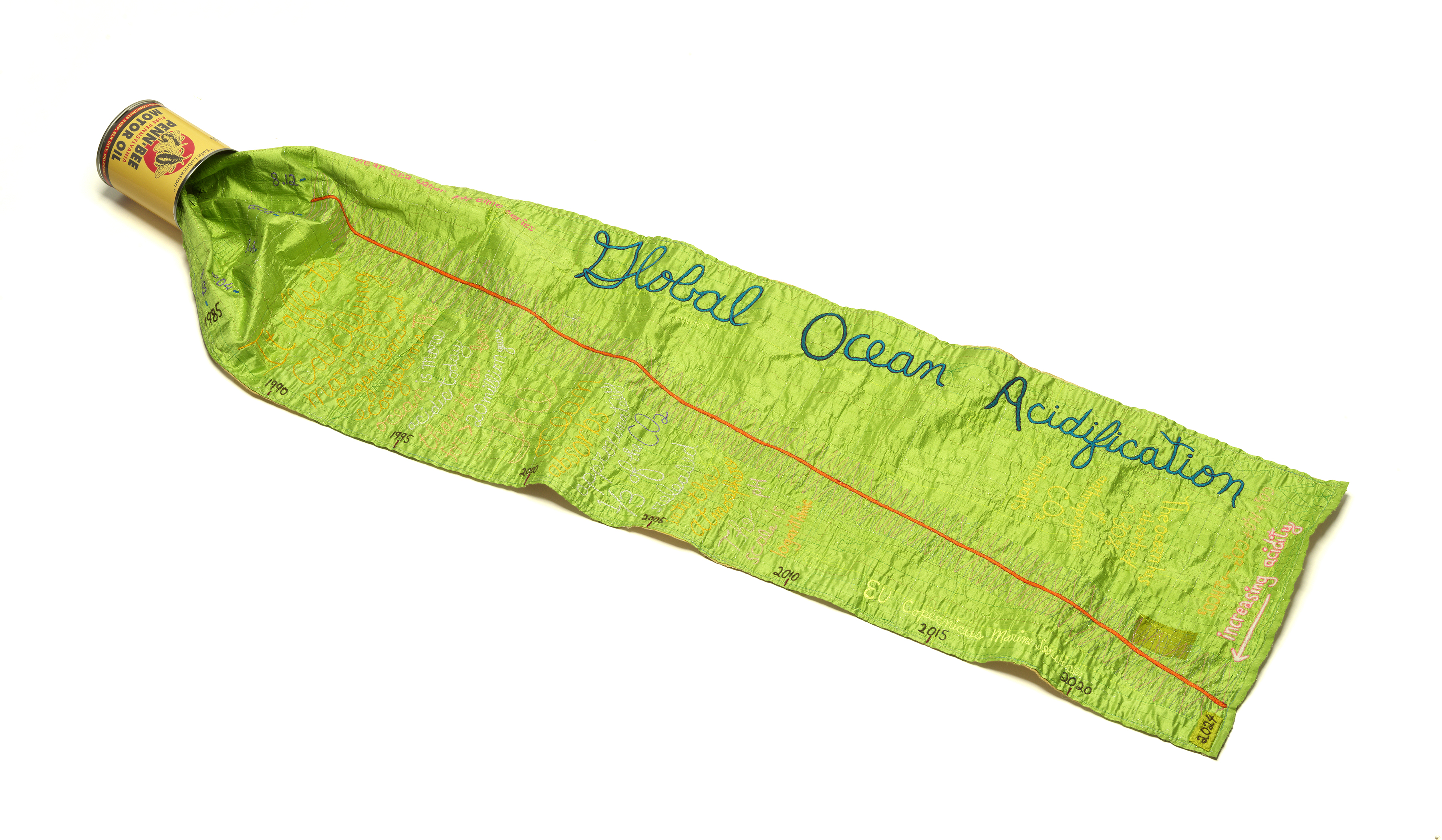
Ocean
Acidification, approx
5 x 8 x 30"
Embroidery on silk
Acidification of the seawater is caused by increasing amounts of carbon
dioxide being absorbed by the ocean. The major causes of this increased
CO2 are fossil fuel combustion, cement production and land-use change.
Calcifying organisms like corals, plankton and shellfish, struggle to
build shells and skeletons due to higher acidity in their environment.
Lower pH values can interfere with the growth and reproduction of marine
organisms and the formation of coral reefs, an important habitat provider
for many species with cascading impacts in the food chain. Another impact
is reduced shoreline protection and increased risk of floods and erosion
caused by coral destruction.
Ocean acidification is quantified by decreases in pH, which is a measure
of acidity. A decrease in pH value means an increase in acidity or acidification.
The observed decrease in ocean pH resulting from increasing concentrations
of CO2 is an important indicator of global change. Between 1985 and 2004
ocean acidity has increased by 17.5%. The pH scale is logarithmic which
means that a small drop in pH
represents a big increase in acidity. If we go back to the pre-industrial
era, this percentage is as high as
40%.
The ocean has absorbed roughly 20-30% of total anthropogenic CO2 emissions
since the 1980s, changing the chemical composition of the seawater and
causing ocean acidification. Seawater is acidifying 10 times faster than
any time in the past 300 million years. The ocean is more acidic today
than it has been for more than 20 million years. Areas such as the Arctic
and Antarctic are seeing significantly larger
decreases in pH than the global average. Ocean acidity is projected to
double or triple by 2100.
For more information, visit: The
Copernicus Marine Service, the
European Environment Agency,
The
Woods Hole Oceanographic Institution
Other oil can graphs are here